
The other day, a colleague asked me why I bothered spending so much time building a course about OCI Azure Multicloud. "Isn’t it just more complexity for complexity’s sake?"
I smiled.
Because I see it differently.
OCI Azure Multicloud isn't a buzzword anymore
In today's cloud-native world, the idea of using more than one cloud provider is no longer hypothetical. It's a growing reality for enterprises across industries. Whether it's due to compliance, cost optimization, failover requirements, or vendor diversification, OCI Azure multicloud is here to stay.
And yet...
Despite the trend, the skills gap is huge. I keep meeting two kinds of professionals:
-
- People who know Azure inside out, but have never touched Oracle Cloud (OCI).
-
- Veterans of OCI (like myself), who are now being asked to build similar infrastructure in Azure.
The learning curve between these platforms is steep. Different naming conventions, different service behaviors, different APIs and consoles. Even something as basic as setting up a virtual network requires different thinking.
Why Bridging the OCI Azure Multicloud Gap Matters
The growing adoption of OCI Azure Multicloud architectures isn't just a theoretical trend — it's already playing out in real enterprise scenarios. Organizations are increasingly distributing workloads across both platforms for strategic reasons: disaster recovery, cost control, data sovereignty, or simply avoiding vendor lock-in.
Yet this flexibility introduces new friction points. Engineers fluent in Azure may find OCI's networking model or IAM system unfamiliar. Conversely, OCI-native architects often feel overwhelmed when facing Azure services like Virtual Machine Scale Sets, Log Analytics, or Azure DevOps.
That’s why bridging the OCI Azure Multicloud skills gap is more than a checkbox. It’s a survival skill.
A common real-world scenario? You have a backend microservice running in Oracle Kubernetes Engine (OKE), but your analytics stack — perhaps built with Azure Data Explorer or Power BI — lives in Azure. Your team now has to:
-
- Provision secure network connectivity across clouds
-
- Harmonize infrastructure as code (Terraform / OpenTofu)
-
- Understand service equivalents (e.g. Azure Load Balancer vs OCI Load Balancer)
That’s not easy without cross-platform training.
What You’ll Gain by Bridging This Gap
Here’s what professionals and teams stand to gain by learning the OCI Azure Multicloud approach:
-
- 🚀 Confidence in deploying real workloads across two major cloud providers
-
- 🔒 Security know-how to manage authentication, encryption, and auditability across domains
-
- ⚙️ IaC mastery using Terraform/OpenTofu to create portable, versioned infrastructure
-
- 📊 Career advantage — multicloud fluency is already a differentiator in hiring pipelines
This is exactly the mindset I’ve embedded in the Multicloud course I’m building — practical, provider-agnostic, and grounded in hands-on work.
There is theory, and then there is reality
Sure, you can read documentation. You can even ask ChatGPT. But theory only gets you so far.
When you're under pressure to deliver real infrastructure — with IaC, secure subnets, backend VMs, load balancers, block storage, or managed databases — you don't want conceptual knowledge. You want repetition, clarity, and working examples.
And let’s face it: in today's overloaded work culture, time is your scarcest resource.
That’s why I built this course
The new FoggyKitchen Multicloud Course is designed to bridge that gap.
Instead of lectures, you get hands-on modules that show how to build equivalent architecture in Azure and OCI. Every lesson is a comparison:
-
- Virtual networking (VNet vs VCN)
-
- Compute instances
-
- Load balancers
-
- Shared file storage (Azure Files vs FSS)
-
- Databases (PostgreSQL vs Autonomous DB)
Each module uses real Terraform/OpenTofu code, tested and documented in GitHub repo. You deploy from your terminal. You verify in the cloud console. You understand why the differences matter.
This is not a course for beginners. It’s for DevOps engineers, cloud architects, and hands-on learners who want to work across cloud boundaries.
The challenge
OCI Azure Multicloud skills are becoming essential. But building them takes effort, and it’s hard to prioritize.
This course is my way of helping you shortcut the process. Not by skipping the work, but by showing exactly where to focus.
If you're ready to grow beyond a single platform, I invite you to take the first step. Let’s build the multicloud skills that employers actually want.
Instead of wrapping up here, why not take the next step? You’ve seen why multicloud skills matter — now it’s time to build them for real.
🚀 Start your journey with the Multicloud Foundations course below — and deploy your first real multicloud setup with Terraform or OpenTofu.
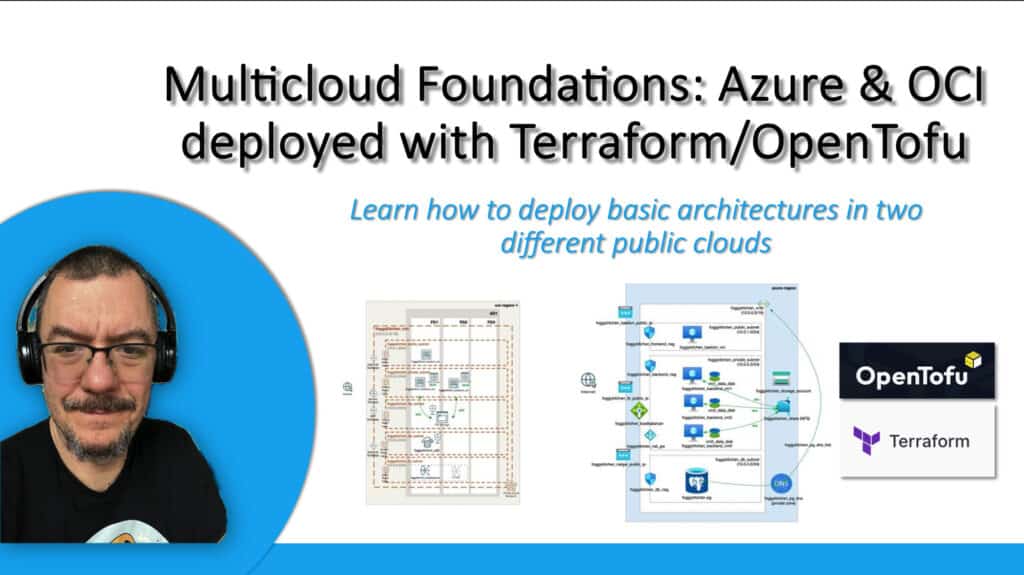
🌍 Master the Multicloud Foundations with Terraform
Build your first production-ready multicloud architectures step by step. Learn how to connect Azure and OCI with Terraform/OpenTofu, and gain the practical skills that cloud engineers need for hybrid environments.
🔥 Start Learning Multicloud Now


