Azure Fundamentals with Terraform/OpenTofu — Build Real-World Azure Architectures with Reusable Modules (2026 Edition)
🚀 Build Azure the Way It Works in the Real World This course is not about clicking through the Azure Portal. This Azure fundamentals Terraform course teaches you how to design and build real-world Azure architectures using Infrastructure as Code. It’s about understanding how Azure actually works — and building …
Overview
🚀 Build Azure the Way It Works in the Real World
This course is not about clicking through the Azure Portal. This Azure fundamentals Terraform course teaches you how to design and build real-world Azure architectures using Infrastructure as Code.
It’s about understanding how Azure actually works — and building it the way real platforms are designed:
with Infrastructure as Code, architectural intent, and reusable modules.
In this hands-on course, you will design and provision a complete Azure platform using Terraform and OpenTofu, step by step — from foundational concepts to production-ready architecture.
You won’t just learn Azure.
You will build it, validate it, and evolve it like a real cloud architect.
🧠 What Makes This Azure Fundamentals Terraform Course Different
Most “Azure Fundamentals” courses focus on services.
This one focuses on architecture.
Instead of isolated demos, you will learn:
- how Azure organizes infrastructure (subscriptions, resource groups, regions, control plane)
- how to design network, compute, and storage as contracts
- how to use, compose, and extend reusable Terraform/OpenTofu modules
- how to think in terms of platform design — not resources
💡 If it’s not in code, it’s not architecture.
🏗️ What You Will Build
Throughout the course, you will progressively build a real Azure platform, including:
- Azure foundation:
- subscriptions, resource groups, regions, control plane
- Networking layer:
- production-oriented Virtual Network (VNet)
- multi-subnet architecture based on responsibilities, not convenience
- Compute layer:
- single VM baseline
- secure workloads with Network Security Groups (NSG)
- load-balanced architecture
- Virtual Machine Scale Sets with autoscaling
- Storage as a first-class architectural component
- Private connectivity:
- Private Endpoints
- Private DNS integration
Everything is built using Terraform/OpenTofu, not the Azure Portal.
🧩 Course Structure
This course is designed as a progressive architecture, not a collection of disconnected demos:
- Foundations
- how Azure organizes infrastructure
- subscriptions as governance boundaries
- resource groups as lifecycle units
- control plane vs data plane
- Networking (Platform Backbone)
- VNet as a long-term architectural contract
- subnet design based on intent and responsibility
- validating network design before workloads exist
- Compute (Workload Contract)
- from “just a VM” to structured architecture
- placement, exposure, and security boundaries
- NSG, Load Balancer, NAT Gateway
- scaling with VM Scale Sets
- Storage
- data as part of platform design
- availability, security, and connectivity considerations
- Private Connectivity
- Private Endpoints and Private DNS
- secure access to PaaS services without public exposure
Each module builds on the previous one — just like real-world platforms.
🧱 Reusable Terraform Modules (Real-World Approach)
This course is built around production-ready Terraform/OpenTofu modules from the FoggyKitchen ecosystem.
You will not build modules from scratch.
Instead, you will learn how to:
- consume modules as architectural building blocks
- compose multiple modules into a coherent platform
- understand and use module outputs as contracts
- validate infrastructure using plan/apply workflows
- evolve architecture without breaking the foundation
This reflects how real-world teams operate:
👉 you don’t rewrite infrastructure
👉 you reuse, integrate, and evolve it
🎯 What You Will Learn
By the end of this course, you will be able to:
- understand Azure as a platform, not a list of services
- design infrastructure using architectural intent
- build Azure environments using Terraform/OpenTofu
- compose reusable modules into real architectures
- separate control plane and data plane responsibilities
- design proper:
- network boundaries
- security layers
- workload placement
- avoid common anti-patterns:
- one subscription for everything
- ad-hoc subnet design
- “just a VM” thinking
👨💻 Who This Course Is For
This course is ideal for:
- cloud engineers who want to move beyond basics
- DevOps engineers working with Terraform/OpenTofu
- Azure users tired of portal-based learning
- architects who want a clean, practical mental model of Azure
- anyone building real infrastructure, not demos
⚠️ What This Course Is NOT
- ❌ Not a certification-focused course
- ❌ Not a beginner “click-through-the-portal” guide
- ❌ Not about memorizing Azure services
This is a hands-on, architecture-driven course.
🍳 About FoggyKitchen
FoggyKitchen is focused on real-world cloud architecture:
- no shortcuts
- no hidden magic
- no portal-driven demos
Just clean, reproducible Infrastructure as Code and production-ready design patterns.
🔥 Final Takeaway
By the end of this course, you won’t just know how to deploy Azure resources.
You will understand how to:
👉 design platforms
👉 encode architecture in code
👉 build systems that scale and evolve
🧩 Explore the Terraform Modules Behind This Course
All infrastructure in this course is built using real, production-oriented Terraform/OpenTofu modules available on GitHub.
👉 Browse the modules and explore the code:
– VNet module → https://github.com/foggykitchen/terraform-az-fk-vnet
– Compute module → https://github.com/foggykitchen/terraform-az-fk-compute
– NSG module → https://github.com/foggykitchen/terraform-az-fk-nsg
– Load Balancer module → https://github.com/foggykitchen/terraform-az-fk-loadbalancer
– NAT Gateway module → https://github.com/foggykitchen/terraform-az-fk-natgw
💡 These modules are designed as reusable building blocks for real-world Azure platforms.
🔗 Continue Your Learning Path
If you want to go deeper and extend this architecture, explore the next steps:
👉 Azure Networking with Terraform
Learn how to design VNet architecture, subnet boundaries, and private connectivity patterns in detail.
→ https://foggykitchen.com/2025/12/18/azure-vnet-terraform-module/
👉 Azure Storage with Private Endpoints
Understand how to integrate storage into your platform using private networking and secure access patterns.
→ https://foggykitchen.com/2026/01/19/azure-blob-private-endpoint-terraform/
👉 Azure Files with Private Endpoints
Build shared storage architectures for workloads using private connectivity.
→ https://foggykitchen.com/2026/01/16/azure-files-private-endpoint-terraform/
👉 AKS with Terraform/OpenTofu
Move from infrastructure to container platforms and production Kubernetes architectures.
→ https://foggykitchen.com/courses/azure-aks-terraform-course/
💡 This Azure fundamentals Terraform course is the foundation. Everything else builds on top of it.
Curriculum
Curriculum
- 7 Sections
- 19 Lessons
- Lifetime
- 🎬 Introduction — Course Overview1
- 🧠 Module 01 — Azure Foundations1
- 🌐 Module 02 — Networking as a Platform Contract4
- 💻 Module 03 — Compute as a Workload Contract6
- 4.1Introduction — From “Just a VM” to Architecture5 Minutes
- 4.2Hands-on — Example 01: Single VM Baseline20 Minutes
- 4.3Hands-on — Example 02: VM with NSG (Security Boundary)21 Minutes
- 4.4Hands-on — Example 03: Private Architecture (LB + NATGW + Bastion)49 Minutes
- 4.5Hands-on — Example 04: VM Scale Set (Autoscaling)18 Minutes
- 4.6Quiz – Compute as Workload Contract5 Questions
- 💾 Module 04 — Storage as a Platform Component5
- 5.1Introduction — Storage as Architecture (Blob vs File vs Disk)8 Minutes
- 5.2Hands-on — Example 01: Blob Storage (Artifacts & Logs)18 Minutes
- 5.3Hands-on — Example 02: File Share (RWX Workloads)14 Minutes
- 5.4Hands-on — Example 03: Managed Disks (VM Storage)18 Minutes
- 5.5Quiz – Storage as a Platform Component5 Questions
- 🔒 Module 05 — Private Connectivity & Secure Architecture5
- 6.1Introduction — Private Connectivity Patterns in Azure5 Minutes
- 6.2Hands-on — Example 01: Storage Network Rules (Public Access Control)11 Minutes
- 6.3Hands-on — Example 02: Private Blob with Private Endpoint28 Minutes
- 6.4Hands-on — Example 03: Private File Access with Private DNS41 Minutes
- 6.5Quiz – Private Connectivity & Secure Architecture5 Questions
- 🎬 Outro — Summary & Next Steps1
Instructor

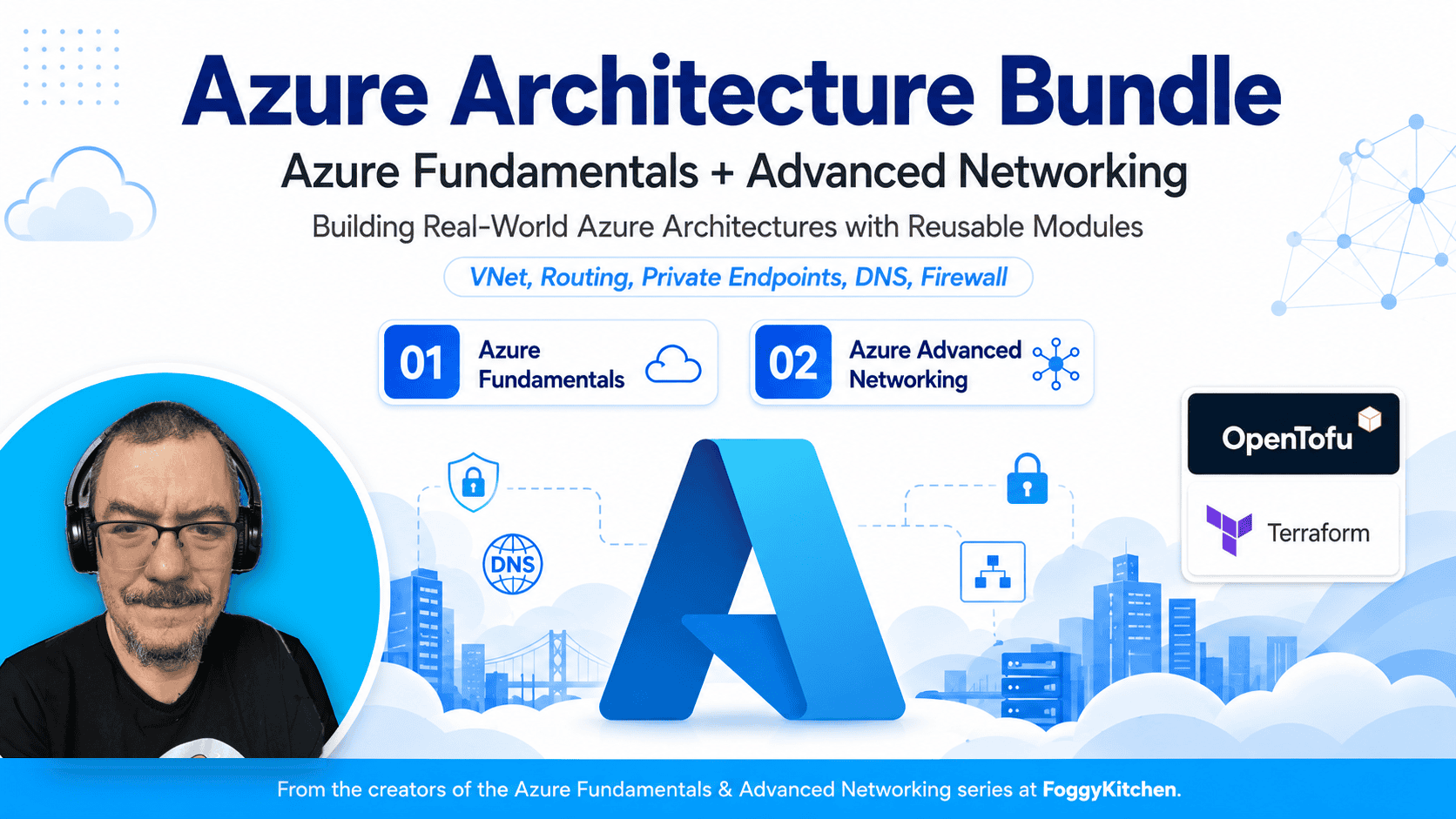
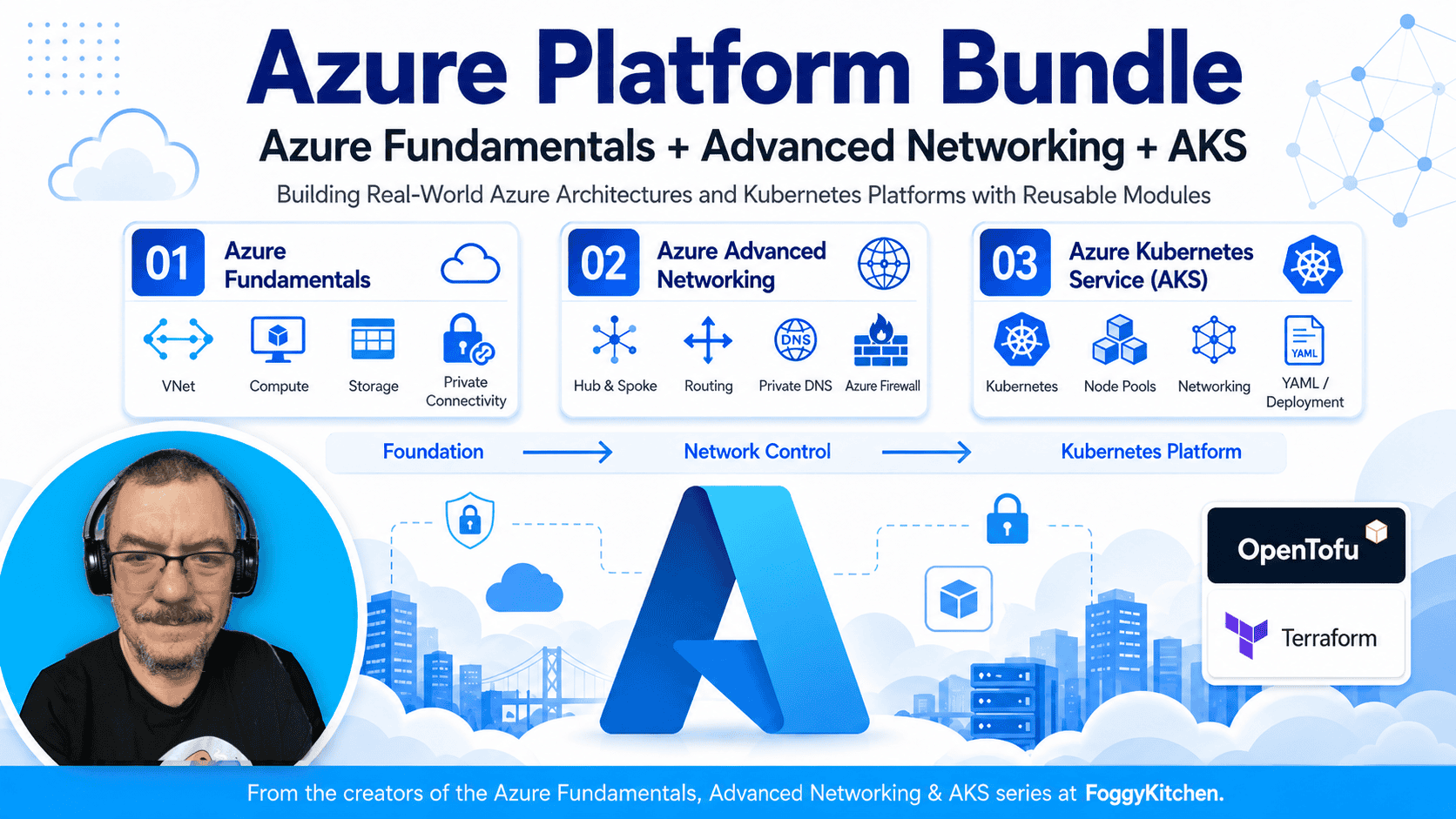
Package
You May Like

Azure Kubernetes Service (AKS) with Terraform/OpenTofu – Hands-On Fundamentals (2025 Edition)
This course is your complete, practical introduction to deploying and managing Azure Kubernetes Service (AKS) using Terraform/OpenTofu.If you want to build production-ready Kubernetes platforms...

Course Features
- Lectures 19
- Quizzes 4
- Duration Lifetime access
- Skill level Intermediate
- Language English
- Students 14
- Assessments Yes