Azure Advanced Networking with Terraform/OpenTofu – Building Real-World Azure Network Architectures with Reusable Modules (2026 Edition)
This Azure advanced networking Terraform course teaches cloud engineers how to design, build, route, secure, and inspect real-world Azure network architectures with Terraform and OpenTofu. 🚀 Build Azure Networking the Way It Works in the Real World This course is not about simple VNet demos or clicking through the Azure …
Overview
This Azure advanced networking Terraform course teaches cloud engineers how to design, build, route, secure, and inspect real-world Azure network architectures with Terraform and OpenTofu.
🚀 Build Azure Networking the Way It Works in the Real World
This course is not about simple VNet demos or clicking through the Azure Portal.
This Azure Advanced Networking with Terraform/OpenTofu course teaches you how to design, build, validate, and evolve real-world Azure networking architectures using Infrastructure as Code.
It is about understanding how Azure networking actually behaves when you move beyond basic connectivity:
- how hub-and-spoke topologies work,
- why VNet peering is not enough,
- how routing decisions are enforced,
- how Private Endpoints and Private DNS change the design,
- and how Azure Firewall becomes the central control point for inspection and policy enforcement.
In this hands-on course, you will build advanced Azure networking patterns step by step using Terraform and OpenTofu — starting from hub-and-spoke connectivity and progressively evolving the architecture into a more realistic, centrally controlled Azure network platform.
You won’t just connect VNets.
You will design traffic paths, validate them, and turn connectivity into architecture.
🧠 What Makes This Azure Advanced Networking Terraform Course Different
Most Azure networking courses explain services in isolation.
This course focuses on architecture, routing intent, and real traffic behavior.
Instead of disconnected demos, you will learn how advanced Azure networking patterns are composed in practice:
- how to design hub-and-spoke topologies,
- how to control traffic flow with User Defined Routes,
- how to introduce a Network Virtual Appliance pattern,
- how to build private connectivity to Azure PaaS services,
- how Private DNS affects cross-VNet access,
- how RBAC and managed identities fit into secure storage access,
- how Azure Firewall replaces a simple router VM as a centralized inspection point.
💡 Connectivity is not architecture. Control is.
🏗️ What You Will Build
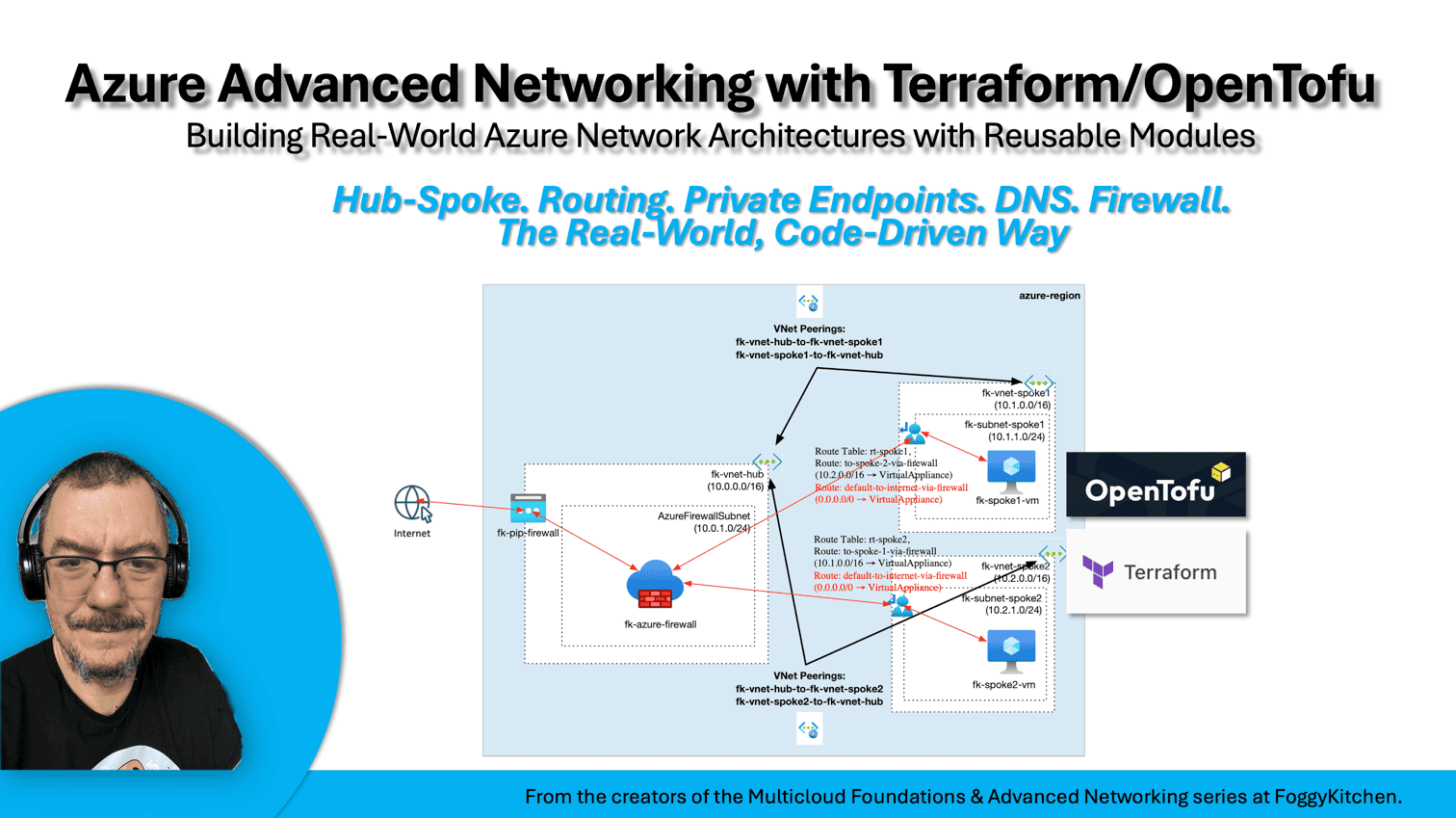
Throughout this Azure advanced networking Terraform course, you will progressively build a real Azure networking architecture, including:
Hub-and-spoke networking:
- hub VNet,
- spoke VNets,
- VNet peering,
- non-transitive connectivity model.
Intentional routing:
- route tables,
- User Defined Routes,
- traffic steering through the hub,
- router VM / NVA-based transit pattern.
Private connectivity:
- Storage Account with public network access disabled,
- Private Endpoint for Blob access,
- Private DNS zone integration,
- cross-VNet DNS visibility,
- managed identity-based access with RBAC.
Centralized inspection with Azure Firewall:
- Azure Firewall deployed in the hub VNet,
- dedicated AzureFirewallSubnet,
- public IP for firewall egress,
- network rule collections for spoke-to-spoke traffic,
- application rule collections for outbound web access,
- UDRs that send both east-west and outbound traffic through the firewall.
Everything is built using Terraform/OpenTofu, validated in Azure Portal, and tested with real commands from inside deployed virtual machines.
🧩 Course Structure
This course is designed as a progressive architecture.
Each module adds one important networking capability on top of the previous one.
Hub-and-Spoke Topology
You start by building a clean hub-and-spoke design using VNet peering. This creates the foundation, but also exposes an important limitation: peering connects networks, but it does not automatically provide transitive routing.
Routing with a Network Virtual Appliance
Next, you introduce a router VM in the hub and use User Defined Routes to send spoke-to-spoke traffic through that VM. This turns simple connectivity into an intentional routing path.
Advanced Routing Patterns
You then extend the routing model and explore how traffic can be redirected through a controlled path. The focus is not only on whether packets can move, but on who controls that movement and where inspection or enforcement can happen.
Private Endpoint Access Across VNets
After routing, you introduce private connectivity. You build a Storage Account with public access disabled, expose it through a Private Endpoint, link Private DNS to both spoke VNets, and use managed identity with RBAC to upload a blob from a VM without storage account keys.
Azure Firewall as a Central Control Point
Finally, you replace the simple router VM concept with Azure Firewall. The hub becomes a central inspection point where both spoke-to-spoke and outbound traffic can be routed, inspected, and controlled using firewall policies and rule collections.
Each module builds on the previous one — just like real Azure networking platforms evolve in production.
🧱 Reusable Terraform Modules
This course is built around reusable Terraform/OpenTofu modules from the FoggyKitchen ecosystem.
You will not build every resource manually from scratch.
Instead, you will learn how to compose modules into advanced Azure networking architectures.
You will work with modules for:
- Virtual Networks,
- VNet Peering,
- Routing and UDRs,
- Compute / VM-based testing,
- Private Endpoints,
- Private DNS,
- RBAC,
- Public IP,
- Azure Firewall.
This reflects how real infrastructure teams work:
👉 they do not rewrite everything from zero,
👉 they compose reusable building blocks,
👉 they validate behavior,
👉 and they evolve the platform layer by layer.
🎯 What You Will Learn
By the end of this course, you will be able to:
- understand Azure networking beyond basic VNet connectivity,
- design hub-and-spoke topologies with architectural intent,
- explain why VNet peering is non-transitive,
- use User Defined Routes to control traffic paths,
- route spoke-to-spoke traffic through a hub-based appliance,
- understand the role of an NVA in Azure networking,
- design Private Endpoint access across multiple VNets,
- configure Private DNS for private Azure service access,
- use managed identity and RBAC instead of storage account keys,
- deploy Azure Firewall as a central inspection and control point,
- route outbound and east-west traffic through Azure Firewall,
- validate architecture using OpenTofu, Azure Portal, and real VM-based tests.
Most importantly, you will learn how to think about Azure networking as a system — not as a set of isolated services.
👨💻 Who This Course Is For
This Azure advanced networking Terraform course is ideal for::
- cloud engineers who already know Azure basics,
- DevOps engineers working with Terraform or OpenTofu,
- platform engineers designing Azure landing zones,
- architects who want to understand real Azure network patterns,
- engineers moving from simple deployments to controlled network architecture,
- anyone who wants to understand routing, Private Endpoints, Private DNS, and Azure Firewall in practice.
This is especially useful if you already understand the basics of Azure infrastructure and now want to move into more realistic platform design.
⚠️ What This Course Is NOT
❌ This is not a beginner Azure course.
❌ This is not a certification-focused course.
❌ This is not a click-through-the-portal tutorial.
❌ This is not a collection of isolated networking demos.
This is a hands-on, architecture-driven course focused on advanced Azure networking with Terraform and OpenTofu.
🍳 About FoggyKitchen
FoggyKitchen is focused on real-world cloud architecture:
- no shortcuts,
- no hidden magic,
- no portal-driven infrastructure,
- no disconnected demos.
Just clean, reproducible Infrastructure as Code and production-oriented design patterns.
The goal is not only to deploy resources.
The goal is to understand why the architecture is designed this way.
🔥 Final Takeaway
By the end of this Azure advanced networking Terraform course, you won’t just know how to deploy Azure networking resources.
You will understand how to:
👉 design controlled traffic paths,
👉 use routing as an architectural tool,
👉 secure PaaS access with Private Endpoints and Private DNS,
👉 introduce centralized inspection with Azure Firewall,
👉 and encode advanced Azure networking patterns in Terraform/OpenTofu.
This is where Azure networking stops being “connected VNets” and becomes a real platform architecture.
🧩 Explore the Terraform Modules Behind This Course
All infrastructure in this course is built using real Terraform/OpenTofu modules available on GitHub.
👉 Browse the modules and explore the code:
– VNet module → https://github.com/foggykitchen/terraform-az-fk-vnet
– VNet Peering module → https://github.com/foggykitchen/terraform-az-fk-vnet-peering
– Routing module → https://github.com/foggykitchen/terraform-az-fk-routing
– Compute module → https://github.com/foggykitchen/terraform-az-fk-compute
– Private Endpoint module → https://github.com/foggykitchen/terraform-az-fk-private-endpoint
– Private DNS module → https://github.com/foggykitchen/terraform-az-fk-private-dns
– RBAC module → https://github.com/foggykitchen/terraform-az-fk-rbac
– Public IP module → https://github.com/foggykitchen/terraform-az-fk-public-ip
– Azure Firewall module → https://github.com/foggykitchen/terraform-az-fk-firewall
💡 These modules are designed as reusable building blocks for real-world Azure platforms.
🔗 Continue Your Learning Path
This course builds naturally on Azure Fundamentals and prepares you for deeper cloud platform architecture.
👉 Azure Fundamentals with Terraform/OpenTofu
Build the foundation first: resource groups, VNets, compute, storage, Private Endpoints, and reusable modules.
→ https://foggykitchen.com/courses/azure-fundamentals-terraform-course/
👉 AKS with Terraform/OpenTofu
Move from infrastructure networking into container platform architecture with Azure Kubernetes Service.
→ https://foggykitchen.com/courses/azure-aks-terraform-course/
👉 Azure Storage with Private Endpoints
Understand how private storage access fits into secure Azure platform design.
→ https://foggykitchen.com/2026/01/19/azure-blob-private-endpoint-terraform/
👉 Azure Hub-and-Spoke Routing with Terraform
Explore how routing and hub-and-spoke patterns work as part of advanced Azure networking.
→ https://foggykitchen.com/2026/04/07/azure-hub-spoke-routing-terraform/
💡 Azure Fundamentals gives you the platform baseline.
This course shows you how to control, secure, and inspect the network architecture built on top of it.
Curriculum
Curriculum
- 6 Sections
- 16 Lessons
- Lifetime
- Module01 - Introduction4
- Module02 - Hub-and-Spoke4
- Module03 - Routing and UDR4
- Module04 - Private Connectivity4
- Module05 - Azure Firewall4
- Outro1
Instructor
Package
You May Like
Azure Fundamentals with Terraform/OpenTofu — Build Real-World Azure Architectures with Reusable Modules (2026 Edition)
🚀 Build Azure the Way It Works in the Real World This course is not about clicking through the Azure Portal. This Azure fundamentals...
Azure Kubernetes Service (AKS) with Terraform/OpenTofu – Hands-On Fundamentals (2025 Edition)
This course is your complete, practical introduction to deploying and managing Azure Kubernetes Service (AKS) using Terraform/OpenTofu.If you want to build production-ready Kubernetes platforms...
🆕 OCI–Azure Interconnect in Practice: FastConnect & ExpressRoute with Terraform/OpenTofu
Hybrid and multicloud connectivity is no longer just a theory — it’s a strategic requirement for modern enterprises. In this hands-on course, we’ll cover...
🆕 Multicloud Advanced Networking: Azure & OCI deployed with Terraform/OpenTofu
Master Multicloud Advanced Networking with Terraform Multicloud advanced networking Terraform is no longer a theory — in this hands-on course, you’ll deploy real, production-grade...
🆕 Multicloud Foundations: Azure & OCI deployed with Terraform/OpenTofu
Deploy real-world multicloud infrastructure using Terraform & OpenTofu – across Microsoft Azure and Oracle Cloud (OCI). This hands-on course is designed for cloud engineers,...
Course Features
- Lectures 16
- Quizzes 5
- Duration Lifetime access
- Skill level Expert
- Language English
- Students 6
- Assessments Yes