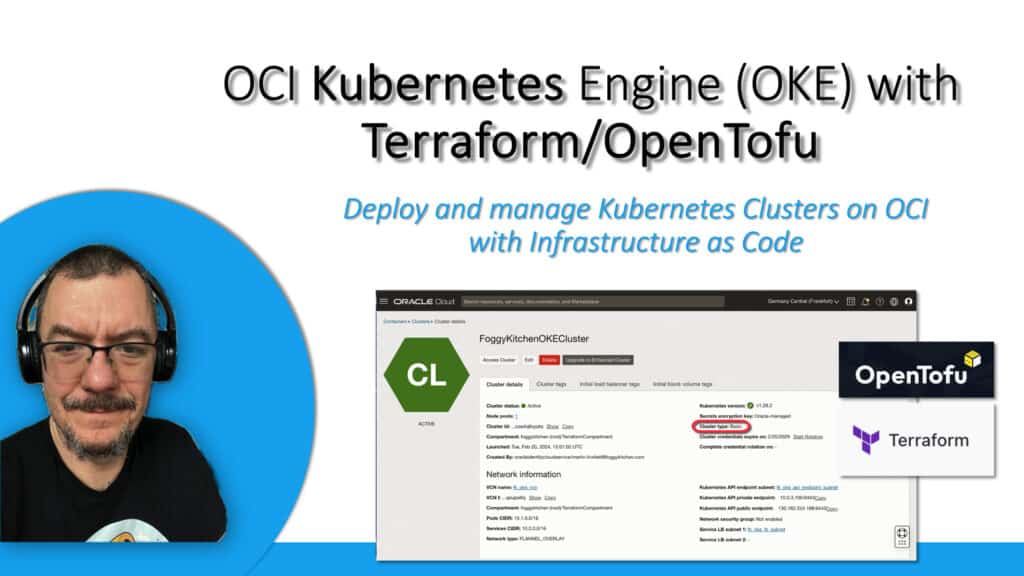
Provisioning OCI Kubernetes Engine (OKE) with Terraform – The Right Way in 2025
Are you looking for a simple way to master OCI Kubernetes Terraform automation? If so, you’re in the right place. Good news — you don’t need to piece everything together manually anymore. I’ve built a ready-to-use Terraform module that handles all the complexity for you, and it’s now featured in our dedicated OCI Kubernetes Engine with Terraform/OpenTofu (2025 Edition) course.
Whether you’re deploying your first Kubernetes cluster on OCI or managing multi-environment automation pipelines, this module will save you hours of setup time.
The Problem with Manual OKE Setup
Setting up OKE manually or even semi-manually with Terraform can be cumbersome. You have to:
Design the VCN and subnets (public and private)
Define load balancer placement
Handle Kubernetes API exposure (public or private)
Configure node pools and node shape settings
Inject SSH keys and additional networking rules
You end up with a lot of boilerplate code that’s error-prone and hard to reuse.
That’s where the terraform-oci-fk-oke module comes in.
The Simplified Solution
In my course and GitHub repo, I’ve published a fully reusable module that abstracts away all the heavy lifting. Here’s a minimal example of how to use it:
module "fk-oke" {
  source                     = "github.com/mlinxfeld/terraform-oci-fk-oke"
  tenancy_ocid               = var.tenancy_ocid
  compartment_ocid           = var.compartment_ocid
  cluster_type               = "basic"
  use_existing_vcn           = false
  is_api_endpoint_subnet_public = true
  is_lb_subnet_public        = true
  is_nodepool_subnet_public  = true
}
This will spin up an OKE cluster with a public API endpoint, load balancer, and node pool — all in a new VCN created by the module. If you want to bring your own VCN or NSG setup, the module supports that too.
Go Further with OCI Kubernetes Terraform

If you’re serious about mastering OCI Kubernetes Terraform automation, it’s worth going beyond the basics. Manually wiring together VCNs, subnets, node pools, and load balancers is a great learning experience, but not something you want to repeat in every environment. That’s where reusable modules and structured learning come into play.
To help you accelerate your learning, we’ve built a comprehensive OCI Kubernetes Terraform course that walks you through all key elements of container infrastructure in Oracle Cloud — from the first cluster to production-ready features like autoscaling, persistent volumes, and advanced load balancing. Each section includes hands-on code from a real GitHub repo, so you can immediately apply what you learn.
You’ll learn how to:
Automate full OCI Kubernetes Engine (OKE) provisioning with Terraform/OpenTofu
Configure flexible infrastructure for stateless and stateful workloads
Use Terraform modules that abstract away complexity
Integrate OCI Block Volume and File Storage as Kubernetes storage backends
Deploy applications using OCI Container Registry (OCIR)
The course is ideal for DevOps engineers, platform teams, and anyone preparing for Oracle Cloud certification. It also includes advanced topics like serverless virtual node pools and cluster add-ons such as CertManager and Oracle Database Operator.
Don’t reinvent the wheel — leverage proven templates and focus on building great apps. Start your OCI Kubernetes Terraform journey with confidence and clarity.
👉 Explore the full course here and get lifetime access.
Learn OCI Kubernetes Terraform the Right Way
If you’re already working with OCI Kubernetes Terraform automation, consider expanding your skills with our OCI DevOps Terraform course. In that course, we use the same Terraform module to deploy cloud-native applications to OKE via OCI DevOps Pipelines. This end-to-end scenario shows how to combine infrastructure provisioning with continuous integration and deployment workflows — the true power of infrastructure as code in practice.
🧠 New to Terraform or OpenTofu?
Are you unfamiliar with Terraform or OpenTofu? Before jumping into OCI Kubernetes provisioning, we strongly recommend taking our Terraform/OpenTofu Flagship Course — designed for beginners and intermediate cloud engineers.
👉 Explore the Flagship Course
Learn the foundations of Infrastructure as Code, automate real-world OCI infrastructure, and become confident with reusable modules like the one featured in this post.
Related OCI Kubernetes & DevOps guides
If you’re looking to go deeper with OKE, container workflows, or production-grade deployments in OCI, these guides will help you extend your cluster with storage, registries, and CI/CD:
🔸 OCI Block Volume with Terraform
How to provision and attach high-performance block storage — ideal for OKE worker nodes.
🔸 Deploying OKE Workloads from OCI Container Registry (Terraform)
A practical walkthrough of building a Docker image, pushing it to OCIR, and deploying on OKE.
🔸 Unlocking OCI DevOps with Terraform (2025 Edition)
A complete introduction to OCI DevOps pipelines, triggers, and artifact flows.
🔸 OCI DevOps Canary Deployments with Terraform
Step-by-step strategy for rolling updates and canary releases integrated with OKE.
Final Thoughts – and Your Next Step
Provisioning OKE manually with Terraform used to be tedious. With the fk-oke module and automation best practices, deploying Kubernetes clusters on OCI has never been easier. But if you want to master the complete workflow — from VCNs to load balancers, node pools, and production-ready clusters — the best way forward is structured learning.
🚀 That’s why I created the OCI Kubernetes Terraform (2025 Edition) course. It takes the concepts from this post and expands them into a full, hands-on program — with reusable Terraform modules, real OCI labs, and step-by-step guidance.
👉 Scroll down to explore the course and start automating OKE the smart way.
🚀 Master OCI Kubernetes Terraform the Smart Way
Build and automate your OKE clusters with my step-by-step Terraform module. Join hundreds of engineers already simplifying Kubernetes on OCI with FoggyKitchen.
🔒 Lifetime • ⏱️ Self-paced • 🧪 Real labs