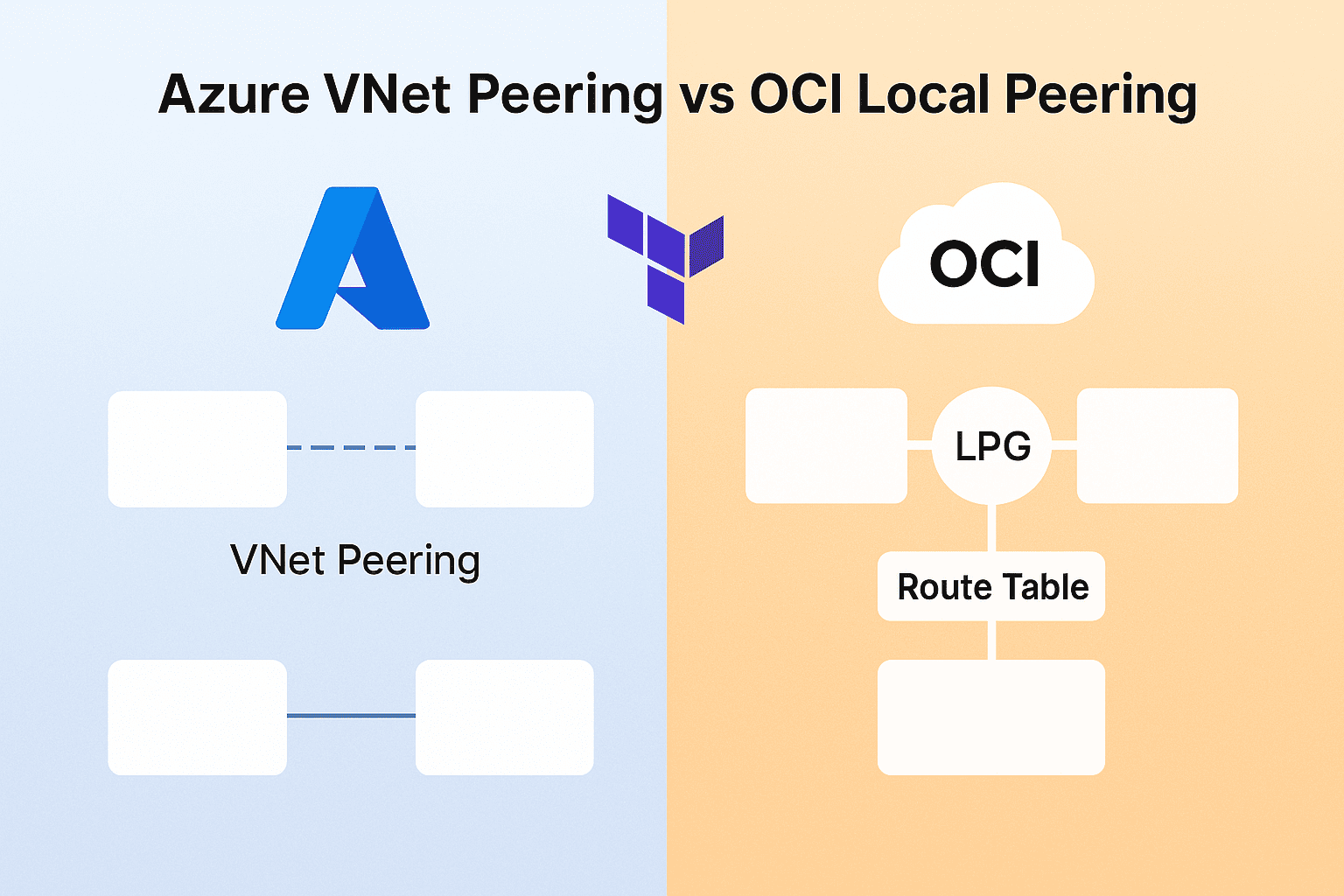
Azure VNet Peering vs OCI Local Peering Gateway with Terraform
- Posted by Martin Linxfeld
- Categories multicloud, networking, opentofu, terraform
- Date August 30, 2025
- Comments 0 comment
- Tags Azure Networking with Terraform, Azure VNet Peering, Cloud Peering, Infrastructure as Code, Multicloud Networking, OCI Local Peering Gateway, OCI Networking with Terraform, Terraform Networking
Introduction
In this article, we compare Azure VNet Peering vs OCI Local Peering Terraform, two approaches to local connectivity in multicloud networking. When designing multicloud architectures, one of the most critical tasks is establishing secure and efficient network connectivity between workloads. Instead of routing traffic through the public internet — which can increase latency, cost, and security risk — both Microsoft Azure and Oracle Cloud Infrastructure (OCI) provide mechanisms for private communication between networks inside the same region. This post compares Azure VNet Peering vs OCI Local Peering Terraform, showing their similarities and differences.
In Azure, this capability comes in the form of VNet Peering, a simple yet powerful construct that allows two Virtual Networks to talk directly. In OCI, the equivalent is the Local Peering Gateway (LPG), which requires a slightly different setup and explicit routing.
While the goal is the same, the implementations reflect the different networking philosophies of each cloud provider:
Azure VNet Peering emphasizes simplicity — minimal configuration, automatic routing.
OCI Local Peering Gateway provides more granular control but also requires explicit route table configuration.
In this post, we’ll compare the two approaches side by side, using Terraform to deploy both, and we’ll look at their respective architectures.
👉 This is a teaser from Lesson 6 of the Multicloud Advanced Networking course available at FoggyKitchen with full labs in the GitHub repo.
Azure VNet Peering
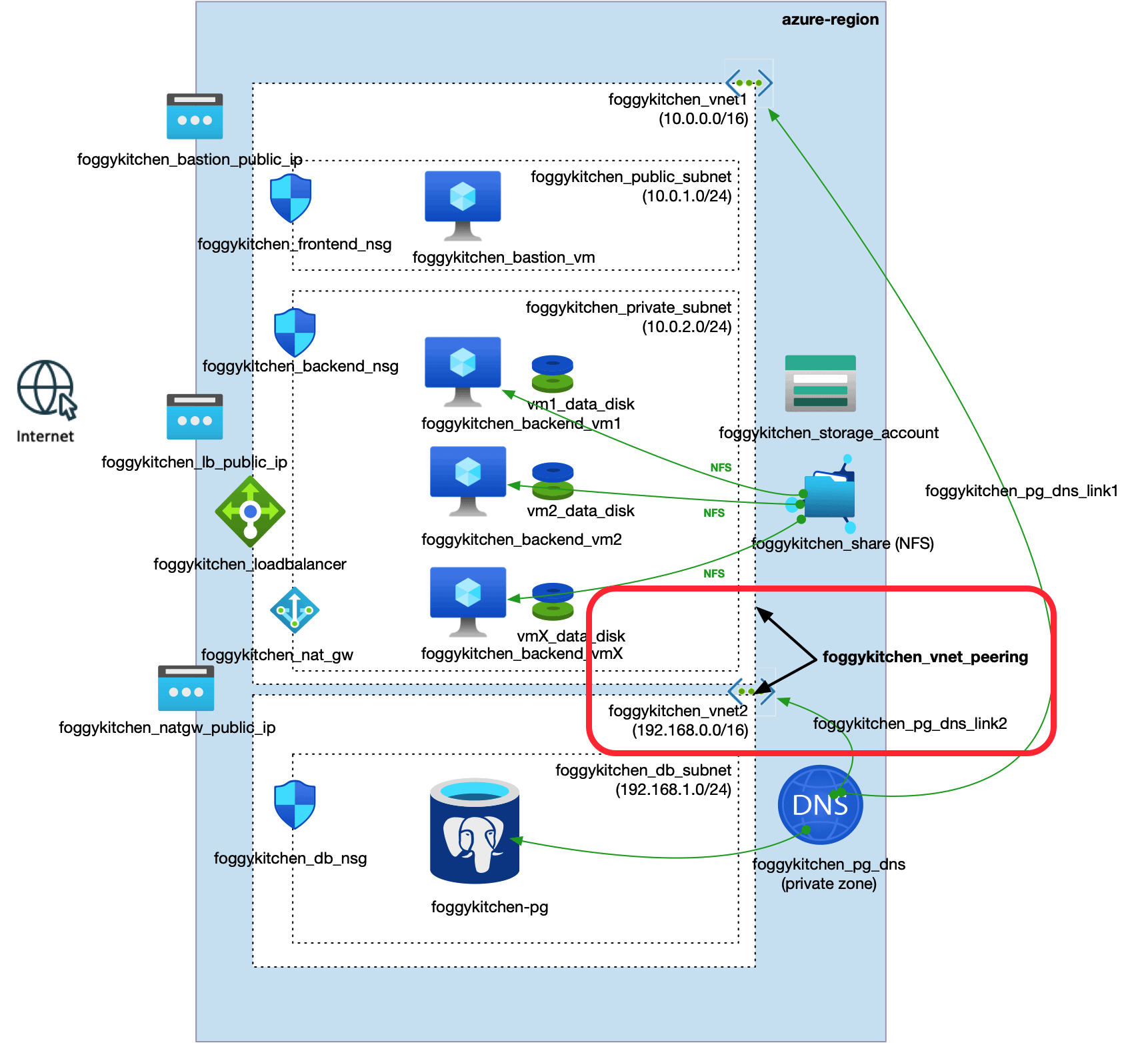
In Azure, there is no distinction between local and remote peering. The same VNet Peering resource is used whether you connect VNets within the same region or across regions. This makes the model straightforward and easy to manage.
Terraform snippet:
resource "azurerm_virtual_network_peering" "foggykitchen_vnet1_to_vnet2_peering" {
  name                      = "foggykitchen_vnet1_to_vnet2_peering"
  resource_group_name       = azurerm_resource_group.foggykitchen_rg.name
  virtual_network_name      = azurerm_virtual_network.foggykitchen_vnet1.name
  remote_virtual_network_id = azurerm_virtual_network.foggykitchen_vnet2.id
  allow_forwarded_traffic   = true
  allow_virtual_network_access = true
}
When working with Azure VNet Peering vs OCI Local Peering Terraform, you’ll notice that in Azure the setup is streamlined and routing is fully automatic.
Key points:
Two resources are required (one in each direction), but routing is automatically handled by Azure.
allow_forwarded_traffic = truelets packets that are routed via Network Virtual Appliances (NVAs) or firewalls be forwarded across the peering.allow_virtual_network_access = trueenables VMs in both VNets to talk directly to each other as if they were in the same network.Transitivity is not supported: if you peer VNet A ↔ B and VNet B ↔ C, VNet A cannot automatically communicate with VNet C. For transit scenarios, you need Azure Virtual WAN.
This shows how, in a direct comparison of Azure VNet Peering vs OCI Local Peering Terraform, Azure reduces operational overhead thanks to automatic routing.
Azure architecture with local peering:
OCI Local Peering
OCI, in contrast to Azure, makes a clear distinction between local and remote peering.
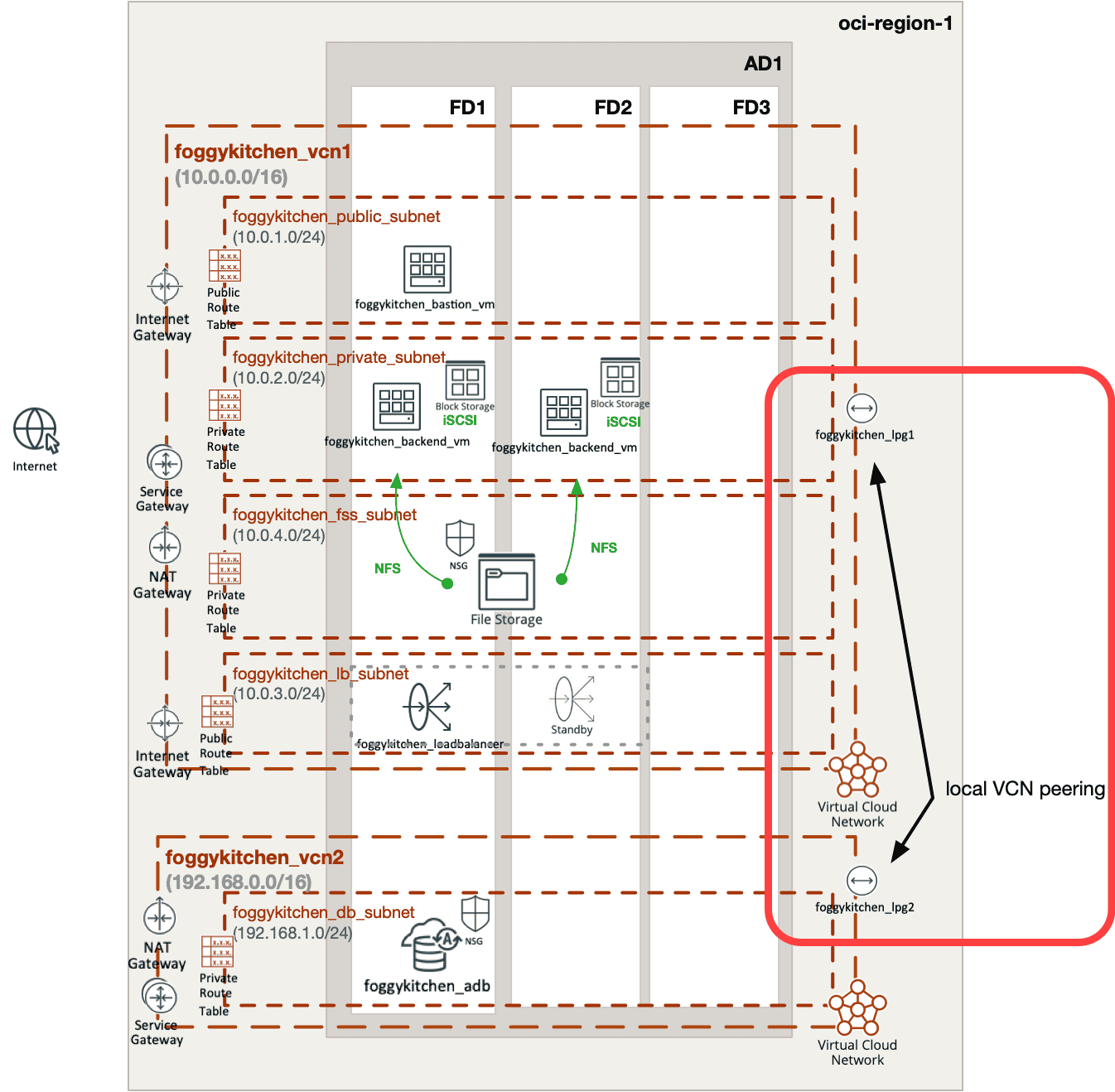
Local Peering Gateway (LPG) – used to connect Virtual Cloud Networks (VCNs) within the same region.
Remote Peering Connection (RPC) – combined with a Dynamic Routing Gateway (DRG), used to connect VCNs across different regions.
In the context of Azure VNet Peering vs OCI Local Peering Terraform, OCI demands explicit routing configuration, which gives you more control but adds complexity.
This explicit model gives architects more control but requires additional configuration steps. Terraform snippet for creating an LPG:
resource "oci_core_local_peering_gateway" "foggykitchen_lpg1" {
  vcn_id      = oci_core_vcn.foggykitchen_vcn1.id
  display_name = "foggykitchen_lpg1"
  peer_id     = oci_core_local_peering_gateway.foggykitchen_lpg2.id
}
Unlike Azure VNet Peering, routing is not automatic. You must explicitly update route tables so that subnets in one VCN can reach the CIDR blocks of the other:
route_rules {
  destination       = "192.168.0.0/16"
  destination_type  = "CIDR_BLOCK"
  network_entity_id = oci_core_local_peering_gateway.foggykitchen_lpg1.id
}
Key points:
You need two LPGs (one per VCN) and explicit route table updates.
This provides fine-grained control over which subnets can talk to each other.
Just like in Azure, transitivity is not supported. If you need multi-VCN transit, you must introduce a DRG or design a hub-and-spoke topology.
From the perspective of Azure VNet Peering vs OCI Local Peering Terraform, OCI requires additional route table management, which gives flexibility but adds complexity.
OCI architecture with local peering:
Azure vs OCI: Key Differences
Below is a side-by-side look at Azure VNet Peering vs OCI Local Peering Terraform, summarizing key architectural and operational differences:
Feature
Azure VNet Peering
OCI Local Peering Gateway (LPG)
Resource type
azurerm_virtual_network_peering
oci_core_local_peering_gateway
Local vs Remote distinction
Same resource (VNet Peering) for both
Separate models: LPG (local), RPC + DRG (remote)
Routing
Automatic (no route table changes)
Manual route rules per subnet
Number of resources
2 (bidirectional)
2 (LPG1 + LPG2) + routing
Simplicity vs control
Simplified, minimal overhead
Explicit, more control, higher complexity
Conclusion
Both Azure and OCI enable private communication between networks in the same region, but their models differ significantly:
Azure VNet Peering with Terraform is designed for simplicity: two peering resources, automatic routing, minimal overhead.
OCI Local Peering Gateway with Terraform requires explicit LPG creation and route table updates, offering more control but also more complexity.
In real-world projects, local peering is typically used to connect frontend and backend VNets/VCNs, or to link application and database tiers without exposing traffic to the internet.
This comparison highlights the importance of understanding each cloud’s networking philosophy when building multicloud architectures.
This article has shown the key differences of Azure VNet Peering vs OCI Local Peering Terraform, highlighting their unique approaches to local connectivity.
👉 If you want to master these concepts step by step, including advanced labs with cross-region peering and hub-and-spoke designs, join my full course: Multicloud Advanced Networking with Terraform.
This Azure VNet Peering vs OCI Local Peering Terraform comparison should give you a clearer sense of when to favor simplicity versus when you need fine-grained control in your multicloud networking designs.
🚀 Master Multicloud Networking with Terraform
Hands-on labs with Azure VNet Peering and OCI Local Peering Gateway. Learn real-world architectures step by step.
🔒 Lifetime • ⏱️ Self-paced • 🧪 Real labs