When working with AKS File Share Terraform deployments, you quickly discover that many real applications need a shared filesystem — something multiple pods can mount at the same time. Upload directories, shared logs, cached assets, configuration files, WordPress media folders, backend pipelines — all require ReadWriteMany (RWX) access. In Azure, …
If you’re exploring AKS persistent storage Terraform, one of the first questions you encounter is the same one developers have been asking for years: “Where do we put the data?” Containers are ephemeral. Pods restart. Nodes churn.Yet your application needs logs, caches, indexes, uploads — anything that must survive lifecycle …
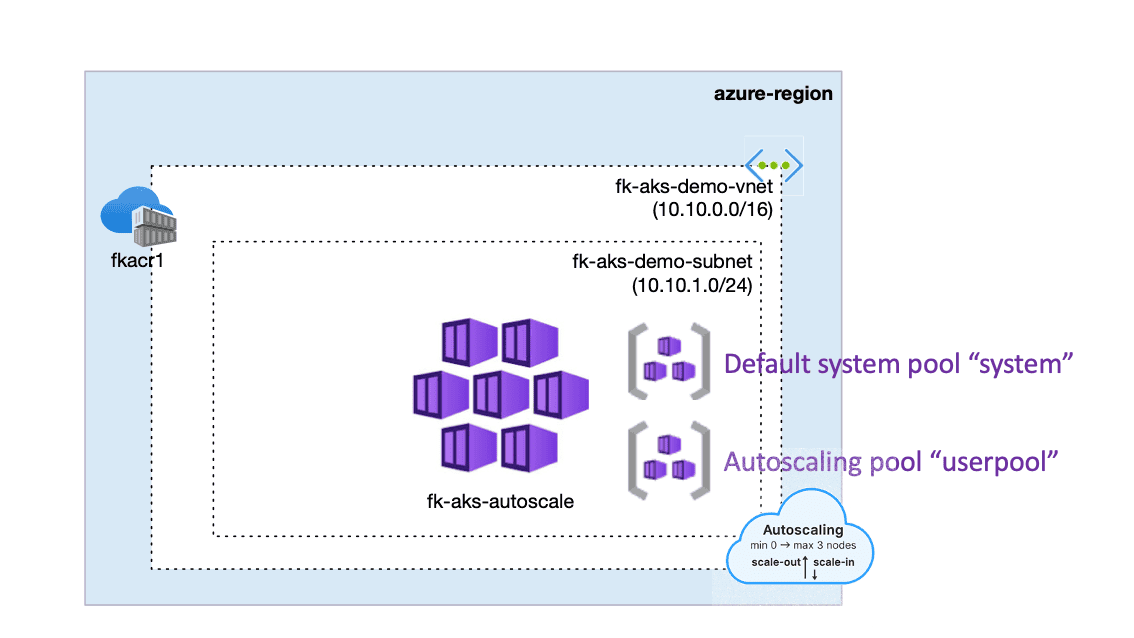
In the previous article, we built a dedicated user node pool in Azure Kubernetes Service (AKS). In this post, we take the next step and introduce the AKS autoscaler Terraform configuration that transforms a static cluster into an elastic one. That setup is already a huge improvement over running everything …
AKS additional node pool Terraform setups are one of the most practical ways to scale and isolate workloads in Azure Kubernetes Service. In this guide, we’ll create a fully functional user node pool and deploy workloads to it using Terraform/OpenTofu. Azure Kubernetes Service (AKS) becomes dramatically more flexible when you …
AKS Log Analytics Terraform is one of the cleanest ways to enable Azure Monitor and Container Insights for your Kubernetes clusters. In this article, I’ll show how the FoggyKitchen AKS module automatically creates a Log Analytics Workspace and connects it to your cluster without any manual steps. Monitoring is one …
In this guide, you will learn how Azure Container Registry Terraform works with AKS when deploying workloads with Terraform — a crucial workflow for any real-world Kubernetes project. When you start automating workloads on Azure Kubernetes Service (AKS), the first real challenge is not the cluster itself — it’s your …
Introduction When building Azure Kubernetes Service (AKS) clusters with Terraform or OpenTofu, networking isn’t just configuration — it’s architecture.AKS supports two main network plugins: Kubenet and Azure CNI. Your choice between them determines how pods receive IPs, how traffic is routed, and how your cluster integrates with existing VNets.In this …
Deploying AKS in private mode is where Azure Bastion Terraform becomes essential. The public API endpoint disappears, your nodes sit deep inside a private subnet, and suddenly the big question is: How do you get inside — safely — without punching holes in your network? That’s exactly where Azure Bastion …